

While we wait to see whether we transition to a fully AI-enabled society, where it is deeply integrated into every aspect of life, or one where adoption remains more modest and fragmented – or somewhere in-between – what we can take a closer look at is the cities where some of the companies that are driving AI uptake are currently based. What these locations have in common?
AI’s long-term real estate impact is still to be determined. IT will largely be predicated on two factors: the pace at which it is adopted by societies, and the level of sophistication or aptitude it reaches.
The cities leading on ‘Deep Tech’
AI falls under the umbrella of ‘Deep Tech’: research-intensive innovations, alongside quantum computing, nanotechnology and biotech – industries which have advanced exponentially over the last decade, securing sizeable venture capital investment and delivering a significant economic boost to the locations where they choose to cluster. Globally, we’ve identified 15 cities that are leading on Deep Tech, having seen a major take-up of offices and lab space both by AI companies and their advanced tech counterparts.
After its real estate market experienced significant upheaval at the start of the decade, the San Francisco Bay Area has made a comeback. As the headquarters location of major AI and microchip companies including OpenAI, Anthropic, Google DeepMind and Nvidia, is unsurprisingly the world’s leading location for Deep Tech, and activity across the sector has helped take-up rates in San Francisco’s office markets recover somewhat from recent lows. Having been the centre of the global tech industry for the last few decades, the area scores highly on all four factors that typically help a Deep Tech city to grow: the presence of highly skilled tech talent and science graduates; leading universities, research institutions and testing facilities; sophisticated venture capital; and robust intellectual property regulation that will help protect these companies’ billion dollar investments.
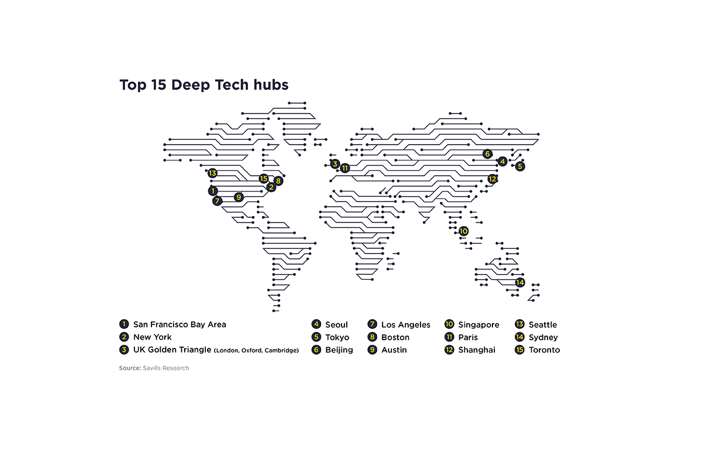
Over on the US east coast, New York comes second in our Deep Tech Index, followed by the UK’s ‘Golden Triangle’ area (London, Oxford and Cambridge), with Seoul and Tokyo rounding out the top five. These cities join San Francisco in currently experiencing strong demand for office and lab space driven by the AI sector. Behind them, however, are coming a wave of other companies. Those which aren’t directly in the AI development space themselves are increasingly looking to locate nearby in order to take advantage of the knowledge environment being created – for instance pharmaceutical companies, which are looking to use AI and deep learning to unlock scientific breakthroughs.
Not just offices and data centres
The real estate effects aren’t just confined to just boosting office take-up. Depending on the occupier, they’re also redefining local building specifications, requiring top tier power capacity, on‑site data infrastructure, enhanced ventilation and, in some cases, clean room facilities. Top AI and Deep Tech talent is also high driving demand for high quality residential accommodation, and, at a local, regional and national level, the industry is driving both investment in and the need to develop extra data centre and power grid capacity.
So, while we may not be able to say yet that we’ve fully entered the AI-age, we can say that there are many cities benefiting from the initial adoption, and that the industry is playing an increasing role in some major real estate markets.


.jpg)